Table of Contents
- Evolution of LED Strip Technology (Quick Context Layer)
- Core Technology #1 — IC Packaging & Driving Technology
- Core Technology #2 — Structural Design of LED Strips
- Core Technology #3 — Control Systems & Smart Lighting Logic
- How These Three Systems Work Together
- Conclusion — Lighting Is Becoming an Intelligent Material
When choosing LED strips, people usually focus on parameters like brightness and power, while paying little attention to other technical aspects—for example, why some LED strip lights produce a much better effect with smooth, dot‑free light. Over the past decade, LED strip technology has undergone a quiet but profound evolution. It is no longer just a roll of flexible circuit board that emits light; it has become a modular electronic lighting system that integrates three major technology fields: semiconductor packaging, circuit design, and software control.
In this article, we will analyze the technology behind lighting performance and explain the details and implementation of LED strip technology from multiple perspectives.
Evolution of LED Strip Technology (Quick Context Layer)
In the evolution of LED strip technology, each generation has made targeted improvements to address the core pain points of its predecessor, thereby achieving a performance leap from basic lighting to intelligent ambient appliances. The following is an overview of the technology evolution at each stage and the key problems they solve:
| Technology Stage | Problem Solved | Key Features |
|---|---|---|
| Traditional SMD LED strips | (Starting point) Basic lighting | Single color or simple white light, visible dot-shaped hotspots, poor heat dissipation, simple control methods (infrared / button) |
| COB LED strips | dot visibility(dot visibility) ; heat(heat dissipation) | Chips are directly mounted, delivering a continuous lighting effect with no graininess; a metal-core PCB improves heat dissipation and extends lifespan. |
| Addressable RGB / RGBIC strips | color control(color control) | Each LED is independently addressable, enabling dynamic effects such as chasing and gradient animations; RGBIC supports break‑point resume (also known as continuous transmission after a break) |
| Smart LED systems (Wi-Fi / Bluetooth / Matter-ready) | intelligence; integration with smart ecosystems | Voice/APP/scheduled control, scene automation, cross-platform connectivity (Apple Home, Google Home, Alexa, etc.) |
Each technological evolution precisely solves the core pain points of the previous generation: from eliminating "graininess" to improving heat dissipation, from free color tuning to integrating into smart ecosystems, ultimately achieving the leap from a "lighting tool" to an "intelligent ambient medium."
Core Technology #1 — IC Packaging & Driving Technology
When delving into LED strips, we inevitably need to focus on the IC packaging method. This technology is very important for the development of LED strips and their lighting performance.

Why IC Matters in Modern LED Strips
In the past, an LED was simply a component that "lights up when powered," but in today's smart LED strips, every single LED can become an independently controllable light node.
The IC (integrated circuit) is the "brain" of each pixel or each segment—it determines color, brightness, timing of effects, and the method of data transmission.
Traditional Constant Voltage Systems
All LEDs respond simultaneously, with no independent control.
Simple circuit structure, using only a constant voltage power supply + current-limiting resistors.
Low cost, but limited effects (at most overall color changing or dimming).
Typical use case: single-color or basic RGB strips, with no chasing, flowing, or other dynamic effects.
Integrated IC (RGBIC / Pixel LED Technology)
The control IC is built into the LED itself or into each segment, enabling separation of the data signal from the power supply.
Core achievable effects:
- Chasing effects
- Gradient animation
- Segmented / pixel‑level independent color control
Common IC examples:
- WS2812B – the most popular built‑in IC in the 5050 package
- SK6812 – similar to WS2812, with better white balance
- TM1814 – supports higher refresh rates and multi‑channel parallel connection
External IC vs Built-in IC Designs
| Approach | External IC | Built‑in IC |
|---|---|---|
| Structure | IC and LED are separate; each IC drives multiple LEDs | IC is packaged inside the LED; each LED is independently controlled |
| Control Granularity | Segment control (typically 3–6 LEDs per group) | Pixel‑level control (each LED has its own address) |
| Cost | Lower | Higher |
| Flexibility | Medium | Extremely high |
| Integration Level | Low | High |
Trade-offs:
- Flexibility vs. Integration Level
- Cost vs. Control Precision
External ICs are suitable for large-scale projects that are cost-sensitive and do not require fine gradients; built‑in ICs are the standard solution for RGBIC and addressable (pixel) LED strips.
Packaging Trends in Modern LED Chips
High‑end LED strips are currently evolving from traditional SMD packaging to more advanced packaging technologies:
- CSP (Chip Scale Package)
Removes traditional substrate and bonding wires; chips are directly mounted, resulting in a smaller size and higher light density. - Flip‑chip structure
Improves thermal conductivity and reduces thermal resistance, making it suitable for high‑power‑density applications. - Mini LED trend
LED chip size is reduced (<200μm), achieving finer resolution and better color mixing while eliminating visible dots (graininess). - Integrated driver design
Integrates both the driving IC and the control IC into a single package, reducing external components and improving reliability.
Key benefits:
- Higher density (more pixels per meter)
- Lower heat generation (improved thermal management)
- Smoother light surface (no visible dots)
- Better energy efficiency (reduced driver losses)
Core Technology #2 — Structural Design of LED Strips
The structural design of LED light strips is also very important. Different applications and different technologies have significantly different requirements for strip structure. Understanding the structural design of LED strips helps in choosing the right one.
Why Structure Matters
The structure of an LED strip directly determines the following key performance characteristics:
- Light uniformity — whether there are visible dots, shadows, or bright spots
- Flexibility — how easy it is to bend, cut, and adapt to different mounting surfaces
- Durability — resistance to bending, waterproof and dustproof rating, long-term stability
- Visual appearance — whether it looks like an "LED strip" or blends into architectural lines and furniture
Different application scenarios (under-cabinet lighting, contour outlining, outdoor accent lighting, in-car ambient lighting) have vastly different structural requirements.

SMD Structure (Traditional PCB-Based Design)
Basic construction:
FR‑4 or flexible PCB substrate + surface‑mounted (SMD) LED chips + external components such as resistors and capacitors.
Structural features:
- Each LED is distributed as a dot on the PCB surface
- Chips are connected to the substrate via solder pads
- Common strip widths: 5mm, 8mm, 10mm, 12mm
Advantages:
- Mature production process, lower cost
- Clear thermal path (heat dissipation can be achieved through copper layer)
- High luminous flux per unit length
Disadvantages:
- Visible dot‑shaped hotspots ("point‑light" effect)
- Obvious graininess when viewed up close
- Requires an additional diffuser cover to achieve a linear light effect
Typical applications: decorative lighting, sign backlighting, and budget‑friendly ambient lighting.
COB Structure (Continuous Light Surface)
Basic construction:
High‑density LED chips directly bonded onto a flexible PCB → covered with a full layer of phosphor/diffusion gel → forming a continuous light source.
Structural features:
- Hundreds or even thousands of chips per meter
- No traditional SMD dot‑style outer packaging
- Overall appearance of a uniform light strip
Key results:
Smoother light output — no visible dots to the naked eye
More uniform diffusion — almost zero mixing distance
Ultra‑thin design possible — overall thickness as low as 1.5–2mm
Disadvantages:
Difficult to replace a single damaged chip (though overall lifespan is long)
Higher heat dissipation requirements at high density
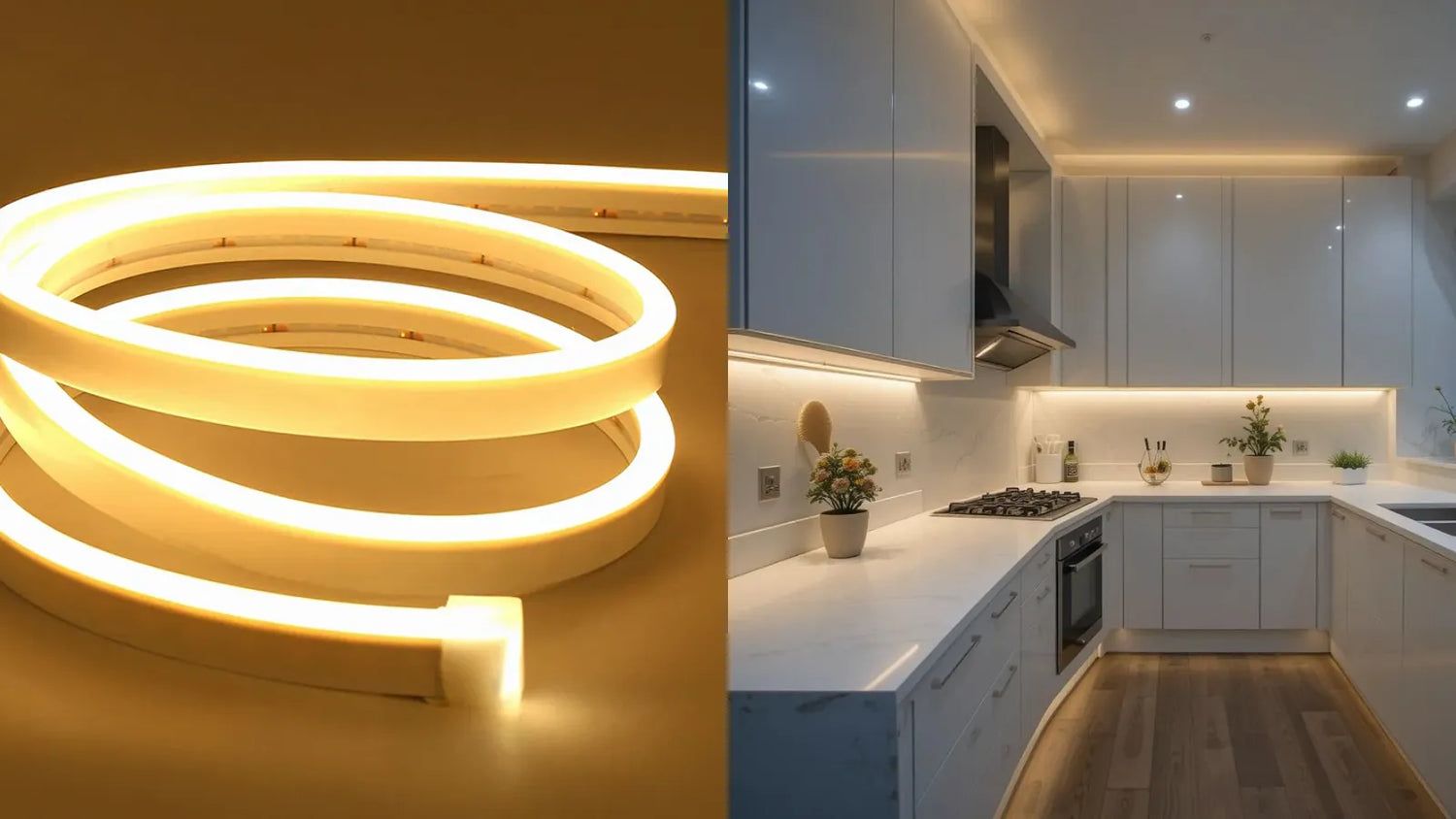
Typical applications: high‑end under‑cabinet lighting, display cases, stair lights (stair rail lighting), and scenarios requiring close‑up viewing by the human eye.
Flexible Neon Structure
| Layer | Material / Function |
|---|---|
| Core light source | Built-in SMD or COB strip as the light source |
| Diffusion layer | Translucent white silicone or optical plastic for even light mixing |
| Outer jacket layer | Colored silicone (often milky white, black, or gray) + UV inhibitors and flame-retardant additives |
| Structural reinforcement | May include internal steel wire or fiber reinforcement to prevent stretching and deformation |
Key features:
- Waterproof performance — Silicone one‑piece extrusion molding, achieving IP65 to IP68
- Architectural‑grade aesthetics — Continuous light with no breaks, simulating glass or acrylic neon effects
- Bendable extrusion design — Supports horizontal bends, vertical bends, and even 3D shaping
- 360° light emission (depending on design) — Standard flat design emits 120°–180°; circular or oval cross‑sections can achieve nearly 360° light output
Structural advantages:
- No exposed substrate, suitable for surface‑mount installations
- UV resistant and salt‑spray resistant (suitable for outdoor use)
- Soft to the touch, able to closely conform to architectural curves
Typical applications: Architectural contour outlining, outdoor channel letters, landscape lighting, hotel/bar decoration, automotive exterior ambient lighting.
Three‑way Comparison
| Structure Type | Lighting Performance | Flexibility | Cost | Typical Applications |
|---|---|---|---|---|
| SMD structure | Dot‑shaped hotspots | Good | Low | General purpose, budget‑friendly |
| COB structure | Continuous uniform light band | Fairly good | Medium | High‑end indoor, close‑up lighting |
| Flexible neon structure | Linear / surface emission, no breaks | Excellent | Medium‑high | Outdoor, architectural, brand decoration |
Core Technology #3 — Control Systems & Smart Lighting Logic
Even LED strips made with advanced technology still need an intelligent control system to achieve diverse lighting effects.
From Electricity to Data-Driven Lighting
In the past, an LED strip simply lit up when powered; today, LED strip behavior is more like a programmable display system.
- Lighting is determined by data, not just voltage or current
- Each LED strip can express complex animations, colors, and interactions like a "display."
- Control methods have evolved from physical switches to software, sensors, and cloud‑based scene automation
Core shift: Lighting as Software.
Analog Control (PWM & Voltage Dimming)
This is the earliest and most basic control method, still widely used in low‑cost or non‑smart LED strips.
Technical principle:
PWM (Pulse Width Modulation): achieves brightness adjustment by rapidly switching the power supply on and off (duty cycle regulation)
Voltage dimming: directly changes the amplitude of the supply voltage (lower efficiency, prone to color shift)
Capabilities:
Basic brightness adjustment (0–100%)
No digital communication cannot achieve segment‑by‑segment or pixel‑by‑pixel control
No data intelligence (does not support animations or scene memory)
Typical applications:
Traditional single‑color or RGB strips + rotary dimmer or simple remote control.
Digital Control Protocols
To achieve more complex dynamic effects, LED strips need to receive and decode digital signals. The mainstream control protocols include:
| Protocol | Features | Typical Applications |
|---|---|---|
| SPI (Serial Peripheral Interface) | Single‑wire / dual‑wire communication, high refresh rate, addressable per LED | Consumer‑grade addressable strips (e.g., WS2812B) |
| DMX512 | Professional differential signal, long‑distance transmission (>100m), frame/channel addressing | Stage lighting, architectural lighting, large‑scale installations |
| UART-based | Custom solution based on serial protocol, commonly found in certain ICs or wireless modules | Custom control systems |
Core capabilities enabled by digital control:
- Multi‑zone control — different segments of the same strip can independently display different colors/effects
- Precise animation timing — millisecond‑level synchronization of lighting effects, enabling complex sequences such as chasing, gradient, and jumping
- Programmability — content can be freely edited via microcontrollers (Arduino, ESP32) or dedicated controllers
Smart Connectivity Systems
Combining digital control with wireless communication turns LED strips into part of the smart home ecosystem.
Main connectivity options:
- Bluetooth control
Short‑range point‑to‑point, ideal for direct connection to a nearby smartphone;
Low latency, no router required;
Typical products: low‑cost smart strips, direct pairing with an app; - Wi‑Fi control
Remote internet control (from anywhere);
Supports multi‑device synchronization, scheduling, and automation scenes;
Can connect to cloud platforms (e.g., Tuya, Xiaomi, Amazon); - Matter‑ready
Next‑gen cross‑ecosystem unified standard (Apple Home, Google Home, Amazon Alexa, Samsung SmartThings);
The strip can be seamlessly discovered and controlled as a Matter lighting device;
Emphasizes local control and security;
Typical functions in the APP
Preset scene library (Party, Sunset, Reading, Romantic)
Music sync (via microphone or streaming audio analysis)
Screen color picker (use your phone's camera to capture a color and apply it to the strip)
Scheduling & automation (triggered by sensors or sunset time)
Voice assistant integration:
"Hey Google, turn the living room strip blue."
"Alexa, set the dining room strip to 30% brightness."
"Siri, turn on the movie scene."
Pixel Mapping & Dynamic Lighting
When every single LED (or every segment) becomes an independently controllable pixel unit, the LED strip turns into a one‑dimensional display.

Core concepts:
Each addressable LED = one pixel (consisting of R, G, B channels)
The controller maps lighting effects to the coordinates of each pixel
Real‑time refresh of each pixel enables animations, text, and even low‑resolution images
Typical Application Scenarios:
| Scenario | Description |
|---|---|
| Gaming peripheral ambient lighting | Changes color in sync with screen content, expanding immersion (e.g., Razer Chroma, Corsair iCUE) |
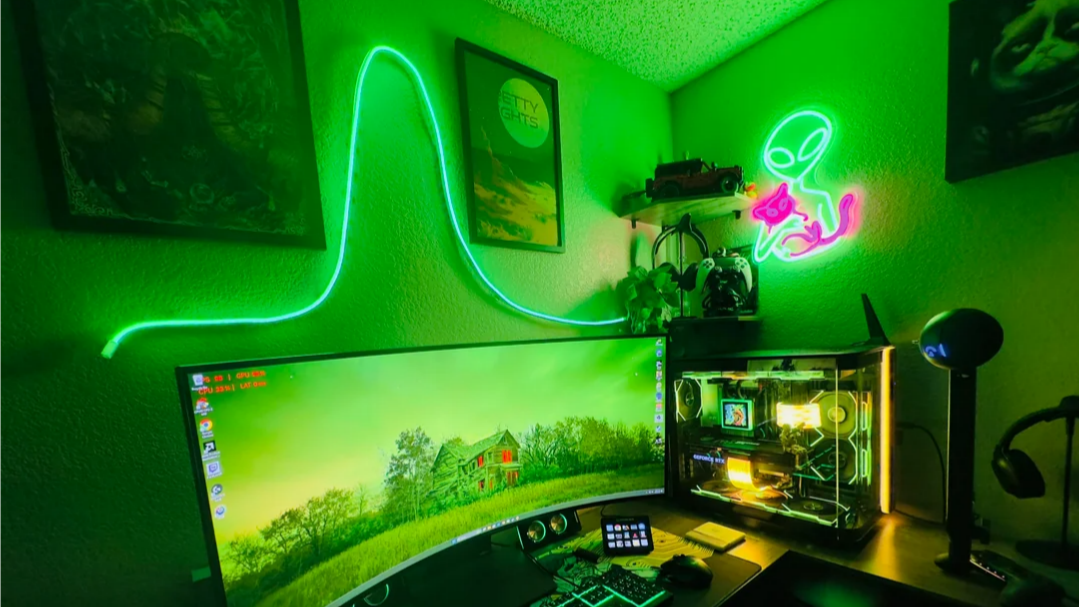
| Ambient wall lighting | Strips mounted behind a TV, monitor, or around walls to create a dynamic ambient glow |
| Immersive room design | Multiple strips form an integrated lighting system that reacts in real time to music, movies, or games |
| Information indication | Examples: ring light on a smart speaker, charging status indicator, notification alert effects |
The intelligence of the control system has evolved LED strips from "decorative lighting" into programmable ambient media that can actively respond to human behavior, environmental conditions, and digital content.
How These Three Systems Work Together
The overall performance of a modern LED light strip is not determined by any single technology alone, but rather by the synergistic effect of three layers: IC, structure, and control system. Each plays a different role, building upon and reinforcing the others.
IC (Integrated Circuit): defines the intelligence level of the strip
It determines whether the strip is "all on/all off" or "each pixel independently controlled," as well as the color depth, refresh rate, and data transmission stability. The more advanced the IC, the greater the animation complexity and expandability the strip can achieve.
Structural design: defines the visual output quality of the strip
It determines light uniformity, presence or absence of graininess, bending adaptability, waterproof rating, and aesthetic appearance. Whether it's SMD, COB, or flexible neon construction, the structure directly affects whether "the final visual effect looks premium."
Control system: defines the interaction experience of the strip
It determines how users interact with the strip: a simple physical switch, or app control, voice commands, automated scenes, or even real‑time content mapping (e.g., game lighting effects). The intelligence level of the control system decides whether the strip can integrate into the modern smart home ecosystem.
Real‑world product synergy examples:
| LED Strip Type | IC Layer | Structure Layer | Control Layer | End‑User Experience |
|---|---|---|---|---|
| Basic RGB strip | No IC or external segment‑control IC | SMD PCB | IR / Bluetooth remote | Overall color change, no independent animation |
| Addressable pixel strip | Built‑in IC (e.g., WS2812B) | SMD, relatively high density | SPI controller + app | Chasing / running effects, segmented scenes |
| High‑end smart COB strip | Built‑in addressable IC | COB continuous smooth light surface | Wi‑Fi + Matter + pixel mapping | Grain‑free addressable light strip, integrated with smart home |
| Outdoor flexible neon | Built‑in IC (optional) | Silicone one‑piece extrusion + diffusion layer | DMX or wireless control | Architectural‑grade uniform light, high protection, remote controllable |
Conclusion — Lighting Is Becoming an Intelligent Material
LED light strips are no longer just auxiliary accessories in lighting systems. They are gradually evolving into programmable architectural elements, mood‑shaping environmental tools, and the core infrastructure of smart homes. The future of lighting is no longer about higher brightness—it is about controllability, intelligence, and system integration. When light can be programmed like data and shaped like a material, it truly becomes an intelligent medium connecting people and the digital world.