








Table of Contents
- What is COB Technology?
- 24V Warm White COB Kit: The First Choice for a Refined Lifestyle
- 120V High-Voltage COB Strip: The Expert for Long Distances and Outdoor Use
- Color Temperature: The Choice Is Not Where You Expect
- CRI 95+ vs. 98+: Can Your Eyes Tell the Difference?
- How to Judge Brightness
- 24V vs. 120V: Lamomo Head-to-Head Comparison
- Cob LED Strip vs SMD LED Strip
- Summary: How to Choose the Right One for You?
If you're tired of the harsh, individual "dots" of light from traditional LED strips, or if you're looking for a lighting solution that glows like a smooth, continuous band of light—congratulations, the COB LED strip light is exactly the answer you've been looking for.
In the past few years, the LED strip market has gone through a major transformation. Once-dominant SMD (Surface-Mounted Device) strips are flexible and practical, but they have one unavoidable flaw: when viewed up close, each individual LED chip is clearly visible. Not only does this ruin the aesthetic, but it also limits their use in high-end interior design, commercial displays, and other demanding applications.
The arrival of COB (Chip on Board) technology has completely changed the game. By densely packing LED chips directly onto the circuit board and coating them with a continuous phosphor layer, COB achieves a seamless, spot-free, uniformly linear glow. In simple terms: a COB strip no longer looks like a series of tiny dots—it looks like a true, continuous "bar of light."
In this ultimate guide, I'll walk you through everything you need to know about COB LED strips from the ground up—how they work, how they compare to regular LED strips, how to choose the right brightness, color temperature, voltage, and CRI, what pitfalls to avoid during installation, and where they work best.
Whether you're a DIY enthusiast, a homeowner renovating your space, or a professional lighting designer, this article will become the most practical reference at your fingertips.
What is COB Technology?
Before we dive into comparisons and buying advice, let's first get the basics straight: what exactly is a COB LED strip? And what does "COB" stand for?
The Origin of COB Technology
COB stands for Chip on Board, which literally means "LED chips mounted directly onto the circuit board." That might not sound particularly special at first, but the key difference is that it eliminates the intermediate steps found in traditional LED packaging.
The typical production process for traditional SMD (Surface Mounted Device) LEDs goes something like this:
LED chip → individually packaged into separate LED components (e.g., 2835, 5050) → those components are then soldered onto a flexible circuit board → finished strip
COB takes a more direct approach:
Multiple LED chips (without individual packaging) are directly die-bonded onto a flexible circuit board → a continuous gold wire connects all the chips in series → a uniform layer of phosphor coating is applied over the entire area → formed in a single step
In simple terms: SMD strips are made by attaching individual "little light bulbs"; COB strips are made as a single, continuous "glowing band."
Structural Features of a COB LED Strip
A typical COB LED strip consists of the following layers, from bottom to top:
- Flexible Printed Circuit (FPC): Typically uses a 2-ounce or thicker copper layer to ensure proper heat dissipation and uniform current distribution.
- LED Chip Array: Chips are placed with extremely tight spacing. Common densities include 288, 320, and 480 chips per meter. Higher density results in more uniform illumination.
- Phosphor Coating Layer: Applied continuously along the entire strip, mixed with phosphor powder. This layer simultaneously performs wavelength conversion (turning blue light into white light) and optical diffusion.
- Transparent or Translucent Silicone/Resin Protective Layer (available on some high-end products): Provides moisture resistance, dust protection, and slightly improves luminous efficiency.
Precisely because there is no individual plastic or ceramic packaging housing, the light emitted from the chips escapes from the sides as well. Combined with the scattering effect of the continuous phosphor coating on top, this ultimately creates a linear light band with no breaks, no dark spots, and no visible individual LEDs.
The Hidden Technical Advantage: Heat Dissipation & Lifespan
Many people don't realize that the COB structure has another hidden benefit—better heat dissipation. Because the LED chips are mounted directly onto the circuit board, with no intermediate packaging material blocking thermal conduction, heat can transfer more quickly to the copper foil and into the air.
At the same power level, the junction temperature of COB chips is typically 5–10°C lower than that of SMD LEDs. This directly translates to a longer service life and less lumen depreciation over time.
24V Warm White COB Kit: The First Choice for a Refined Lifestyle
If you're looking for a lighting experience that's "easy on the eyes, hassle-free to use, and controllable with a remote," then this 24V COB LED strip kit is practically tailor-made for a refined lifestyle. It comes in three color temperatures—3000K Warm White, 4000K Natural White, and 6000K White (availability depends on the length you choose—see the table further down)—so it isn't limited to a single "warm" look. Let's take a look at why it stands out as the top choice.

1. Truly Uniform Light
Regular COB strips are already much more uniform than SMD strips, but this one goes a step further—it features a transparent diffuser cover that improves light mixing by up to 97%. Combined with a 180° wide beam angle and 24V low-voltage technology, the entire strip lights up with no dark spots or shadows anywhere.
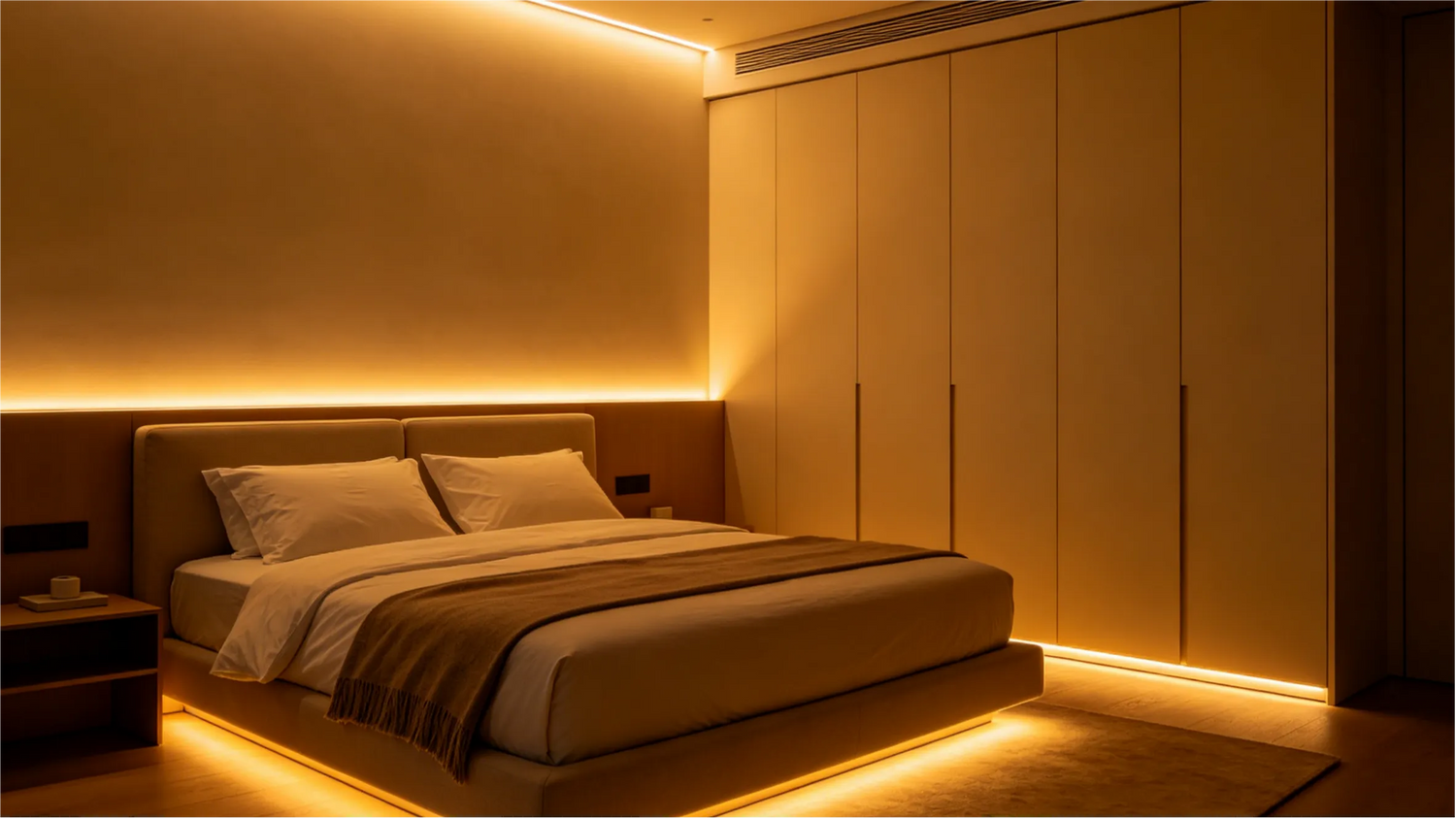
When used under kitchen countertops or behind a bedroom headboard, the light spreads out like a soft, continuous band—completely free of any grainy appearance.
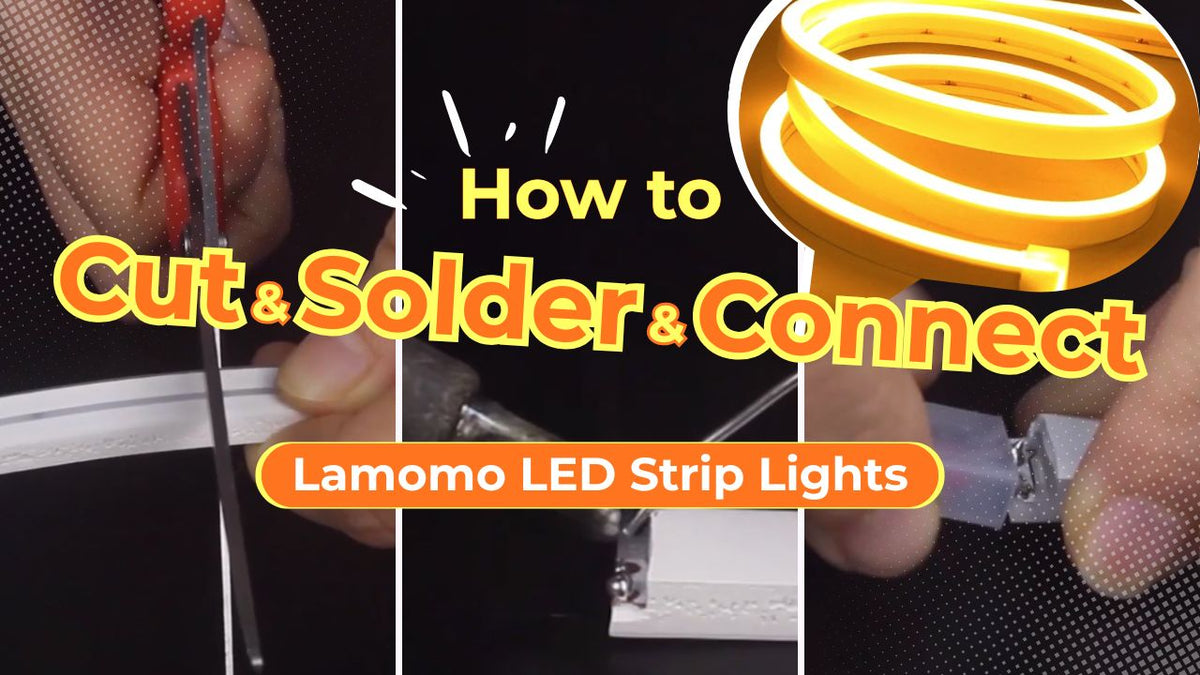
2. DIY-Friendly – Cut and Connect Without Soldering
There's a cutting point every 5cm, and with the included quick connectors, you don't need a soldering iron at all.
Even better, its reinforced silicone sleeve both holds the shape you bend it into permanently (e.g., letters, logos, curved decorations) and remains flexible enough to bend nearly 180°. Whether you're making custom signage, creating commercial displays, or routing along furniture contours, it won't spring back or deform.
3. Truly Waterproof – Works Indoors and Outdoors
Many strips claim to be waterproof but only offer basic splash resistance. This one uses a fully encapsulated silicone housing, with a waterproof rating high enough to withstand direct exposure to poolside conditions or even heavy rain.
What's more, the silicone material is inherently flame-retardant—it won't catch fire even when exposed to an open flame, and the LEDs won't go out as a result.
Note: The power plug and end caps themselves are not waterproof. For outdoor use, you'll need to place the connection points inside a waterproof junction box or keep them out of rain-exposed areas.
4. Safe, Durable, and Fully Certified
24V low voltage means there's no risk of electric shock from accidental contact, giving you peace of mind if you have pets or children at home. The low-power design also helps you save on electricity.
120V High-Voltage COB Strip: The Expert for Long Distances and Outdoor Use
If you need a single LED strip to light up dozens of feet of eaves, patios, or commercial display windows—or if you don't want a bunch of power adapters cluttering your walls—then the 120V high-voltage COB strip is made for you. It's designed specifically for long-distance, large-area continuous lighting, while retaining the uniquely uniform glow of COB technology.

1. Longer, Brighter, More Uniform
This high-voltage COB strip features a high-density layout of 288 chips per meter, with a width of 9.2mm. Combined with a 180° wide beam angle and a color rendering index (CRI) of 95+, the light is not only bright and uniform but also reproduces true colors—reds look redder, wood grain looks more natural, and food looks more appetizing.
The biggest game-changer is its continuous power delivery capability of up to 98.4 feet (approx. 30 meters).
With standard 12V/24V low-voltage strips, brightness noticeably drops off after 5–10 meters. But the 120V high-voltage design ensures that the entire strip has nearly identical brightness from head to tail—no more awkward "bright at the start, dim at the end." It plugs directly into a standard wall outlet, so there's no external power adapter to hide. That means one less black box on-site for a cleaner installation.
One thing to know upfront: this strip is fixed-brightness only—there's no remote, no dimmer, and no lighting modes. Once it's plugged in, it's on at full output.
2. Easy Installation, Includes Long Power Cord
Cutting points: Marked every 50cm, so you can cut to the desired length. After cutting, be sure to seal the end with electrical tape or heat-shrink tubing to prevent leakage (high-voltage safety is critical).
Power cord: The kit includes a 1.8-meter (approx. 6 ft) power cord, longer than most similar products, making it easy to route the plug to an indoor outlet or waterproof enclosure.
Mounting accessories: Includes expansion anchors for hard surfaces such as concrete walls or wooden studs (20 pcs per kit), plus mounting clips (40 pcs for the 65.6 ft version, 60 pcs for the 98.4 ft version), waterproof silicone end covers (2 pcs), and glue (10ml) for sealing cut ends—everything you need for a finished install is in the box.
Color Temperature: The Choice Is Not Where You Expect
Lamomo offers three whites, but which ones you can pick depends on which strip—and which length—you choose:
24V COB Kit — color temperature by length
| Length | 3000K Warm White | 4000K Natural White | 6000K White |
|---|---|---|---|
| 2m / 6.56 ft | ✓ | ✓ | — |
| 3m / 9.84 ft | ✓ | ✓ | — |
| 5m / 16.4 ft | ✓ | ✓ | ✓ |
| 6m / 20 ft | ✓ | ✓ | ✓ |
| 10m / 32.8 ft | ✓ | ✓ | ✓ |
| 20m / 65.6 ft | ✓ | — | — |
120V COB Strip — color temperature by length
| Length | 3000K | 4000K |
|---|---|---|
| 65.6 ft / 20m | ✓ | ✓ |
| 98.4 ft / 30m | ✓ | — |
So if you specifically want 6000K, you're limited to the 24V kit in 5m, 6m, or 10m lengths. And if you want the longest possible single run (98.4 ft), your only color option is 3000K Warm White.
3000K Warm White — available across both product lines and nearly every length. This is the classic cozy glow. Think candlelight, sunset, your favorite café. It flatters skin tones, makes food look inviting, and turns any room into a relaxing retreat. If you're lighting a bedroom, living room, or any space where you want to feel at home, this is your color.
4000K Natural White — available on the 24V kit (2m–10m) and the 120V 65.6 ft strip. This is natural daylight without the harsh edge. Clean, clear, and easy on the eyes. It's ideal for kitchen counters where you're prepping meals, home offices where you're reading fine print, or bathrooms where you want an honest reflection in the mirror.
6000K White — available on the 24V kit only, in 5m, 6m, and 10m lengths. This is bright, crisp, and energizing. Think of a clear midday sky that keeps you alert and focused. It's perfect for garages, workshops, laundry rooms, or any task space where you need maximum clarity and contrast.
To know more about color temperature:
| Color Temp | Visual Feel | Best For | Pick this |
|---|---|---|---|
| 2700K–3000K Warm White | Cozy, candle-like, relaxing | Bedrooms, living rooms, restaurants, ambient coves | 24V COB, 120V COB |
| 3500K–4000K Neutral White | Clean, natural, alert but not cold | Kitchens, bathrooms, offices, task lighting, commercial displays | 24V COB, 120V COB 65.6 ft |
| 5000K–6500K Cool White | Clinical, high-contrast, energizing | Garages, workshops, inspection bays | 24V COB (5m/6m/10m only) |
CRI 95+ vs. 98+: Can Your Eyes Tell the Difference?
What Is CRI, and Why Should You Care?
CRI stands for Color Rendering Index. In plain English: it's a score that tells you how "honest" a light source is.
Sunlight scores a perfect 100. Under the sun, a red apple looks red, your skin looks like your skin, and a white wall looks white. Artificial light tries to match that honesty. CRI tells you how close it gets.
- CRI 80 — the legal minimum. Colors look... fine. But put a red sweater under it and the red turns slightly muddy. Put your hand under it and your skin looks a little gray. Most cheap LED strips live here.
- CRI 90+ — now we're talking. Wood grain looks rich. Food looks appetizing. Faces look healthy. This is where quality LED strips start.
- CRI 95+ — excellent. You'd be hard-pressed to complain about color under this light. Most people would call it "perfectly natural." This is where Lamomo's 120V COB strip sits.
- CRI 98+ — exceptional. Side by side with sunlight, it becomes difficult to tell the difference. This is where Lamomo's 24V COB kit sits.
Here's the thing: Once you hit 95+, you're already in "great" territory. The jump from 95 to 98 is real, but it's subtle. Think of it like the difference between a very good camera and a professional camera. For Instagram? You won't notice. For a magazine cover? It matters.
So When Should You Reach for 98+?
Reach for it when the light is close to people, close to color-critical objects, or close to food.
- Makeup mirrors and vanities. You want your foundation to match your neck in the bathroom and in the office elevator. CRI 98+ makes that transition seamless.
- Kitchens and dining areas. That salmon fillet should look as fresh under your strip light as it does on the plate. High CRI makes food look alive instead of plastic.
- Artwork, photography, or craft spaces. If you're judging paint colors, fabric swatches, or printed photos, every point of CRI counts.
- Retail displays. If you're selling products that people need to want with their eyes, high CRI is silent salesmanship.
When Is 95+ Perfectly Enough?
- Outdoor lighting. Eaves, patios, garden paths. You're ten feet away, looking at architecture and shadows, not inspecting color swatches.
- General ambiance. Behind a headboard, inside a ceiling cove, under a sofa. The goal is mood, not color critique.
-
Long commercial runs. Storefront windows, building façades. The convenience of a long, bright, even wash outweighs the marginal gain of 98+.
How to Judge Brightness
Wattage is not brightness. Two strips can draw the same power and put out very different amounts of light, so here's what actually matters when you're comparing options:
LED density (chips per meter) is your best available proxy. The 24V kit runs 320 chips/m; the 120V strip runs 288 chips/m. Both are dense enough to disappear into a seamless COB glow with no visible dots, but the 24V kit's slightly higher density makes it the better pick when the strip will be viewed up close—inside a glass display case, under a floating shelf at eye level, or along a headboard you'll be resting against. The 120V strip's density is plenty for the wider viewing distances typical of eaves, façades, and patios.
The diffuser and beam angle matter as much as the chip count. Both strips use a 180° beam angle, meaning light spreads across a full hemisphere rather than shooting straight down—this is what prevents a hot center stripe and dark edges in a cove or channel. The 24V kit's diffuser cover is rated for up to 97% light mixing.
24V vs. 120V: Lamomo Head-to-Head Comparison
| Dimension | Lamomo 24V COB Kit | Lamomo 120V COB |
|---|---|---|
| Color Temperatures | 3000K (all lengths), 4000K (2m–10m), 6000K (5m/6m/10m only) | 65.6 ft: 3000K or 4000K; 98.4 ft: 3000K only |
| CRI | 98+ | 95+ |
| LED Density | 320 chips/m | 288 chips/m |
| Max Single-End Run | ~5 m before visible dimming on a single feed | 30 m (98.4 ft) with no brightness drop |
| Cutting Interval | Every 5 cm | Every 50 cm |
| Dimming | RF remote included; 10–100% dimmable, timer, Fade/Jump/Flash modes | None — fixed brightness, no remote |
| Power Supply | External 24V DC adapter/transformer included (sized to length, 1.5A–3.0A) | Plugs directly into a standard wall outlet; no external adapter |
| Waterproofing | IP65 silicone sleeve, flame-retardant (end caps only included on 5m+ lengths) | IP65, outdoor-rated, end caps included on both lengths |
| Power Supply | External 24V DC adapter/transformer included (sized to length, 1.5A–3.0A) | Plugs directly into a standard wall outlet; no external adapter |
Cob LED Strip vs SMD LED Strip
Now that you understand the basic principles of COB LED strips, the 24V refined kit, and the 120V high-voltage long-distance solution, an inevitable question naturally arises: COB vs. traditional SMD strips—which one should you choose? What are the fundamental differences in brightness, uniformity, heat dissipation, price, and suitable applications? When is it worth spending a little extra on COB, and when is SMD actually the better option?
We've actually written a very detailed comparison blog post on COB vs. SMD topic. In that article, you'll find:
- COB Strip vs SMD Strip: What Are They?
- COB Strip vs SMD Strip: What Are the Differences?
- Commercial Use Cases: COB vs SMD LED Strips
- Residential Use Cases: COB vs SMD LED Strips
- FAQs: COB & SMD Strip Lights
Summary: How to Choose the Right One for You?
By now, you have a complete understanding of COB LED strips, from the basic principles to specific products. In this final step, let's get back to the most practical question: standing in front of the shelf (or your shopping cart), which one should you actually pick?
Below, based on different usage scenarios and needs, I've laid out three clear decision paths for you.
Scenario 1: Indoor refined ambiance + remote control convenience + occasional DIY shaping
Choose the 24V low-voltage COB kit. It's safe, offers remote dimming and scheduling, allows solderless cutting every 5cm, and can be bent into custom shapes. It also comes in three color temperatures, so you can match the exact mood of the room—just double-check that your preferred color temperature and length combination is actually available (6000K, for example, only ships in 5m, 6m, and 10m). Perfect for kitchens, bedrooms, closets, and staircases.
Scenario 2: Extra-long distances (up to 98 feet) for outdoor or commercial lighting
Choose the 120V high-voltage COB strip. With up to 98.4 feet (30 meters) of single-end power delivery and no brightness drop-off, IP65 weather resistance, and CRI 95+, it's ideal for eaves, patios, and commercial building facades. Just remember it's fixed-brightness with no remote, and be sure to follow high-voltage safety rules (never coil while powered, install with power off, and insulate the cut end).
Scenario 3: Still torn between COB and SMD
Read our detailed comparison article first. In a nutshell: if you're afraid of seeing visible light spots and care about light quality, go with COB. If you're on a tight budget or the strip will be hidden from view so you never see the individual LEDs, SMD is still a solid choice.
No matter which COB strip you finally choose, one thing is universal: the first time you light it up and see that continuous, soft, spot-free band of light, you'll feel that all the indecision was worth it.
If you still have specific questions—like the actual power draw of a certain strip light, how to integrate it with smart home systems, or any odd issues you run into during installation—feel free to leave a comment below. I'll do my best to reply to each one.