Table of Contents
I know you have many questions about choosing LED light strips, so let’s keep things simple:
If you want seamless lighting → choose COB Strip
If you care about price & flexibility → choose SMD Strip
If you want a luxury, high-end lighting effect → choose COB Strip
If you want a fun, colorful party vibe → choose SMD Strip
If you're investing in premium interior design → choose COB Strip
If you're on a budget → choose SMD Strip
Okay, now do you clearly know what kind of light strip you should choose? Match it to your own needs and budget, and you'll always make the right choice.
COB Strip vs SMD Strip: What Are They?
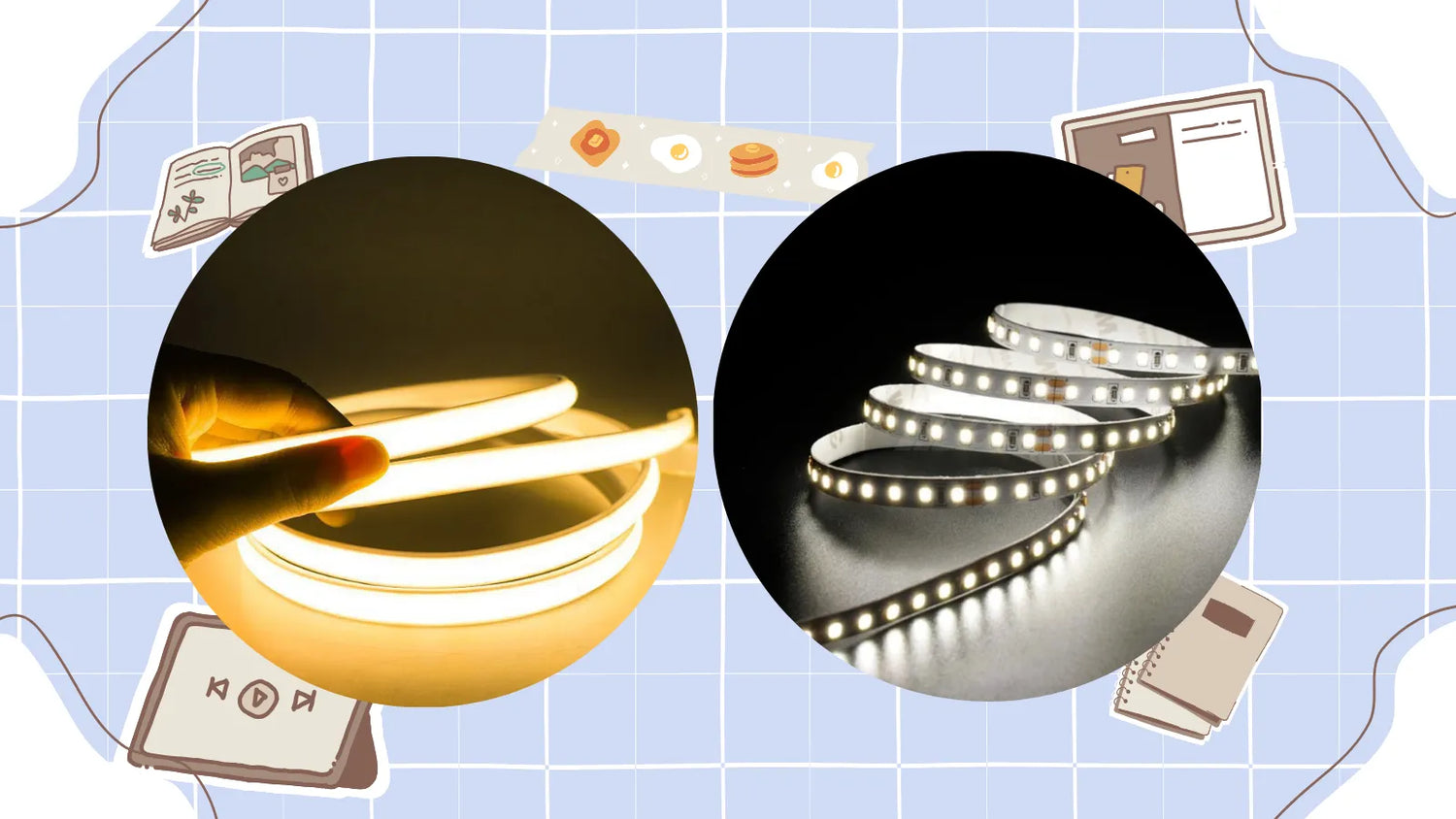
An SMD light strip consists of individual LED beads arranged in a line, giving it a dotted or grainy appearance. A COB light strip, on the other hand, provides a continuous, uniform glow along the entire strip, much like a glowing flexible tube.
SMD Strip Light
SMD = Surface Mount Device, which is the most traditional and common type of LED light strip. On the surface of this type of light strip, you can clearly see individual small square LED beads. Common models include 2835, 5050, 3528, etc. There are also noticeable gaps between the beads on the strip.
For more details, please refer to the image below:

From the image, you should now have a good understanding of what SMD light strips are like. So what are the characteristics of this type of light strip?
- First, SMD light strips are affordable. Most users are using them, so they are very popular and widely available.
- They come in rich colors and offer high brightness. Users can use them in places like bars, parties, and stores.
- When viewed up close, you can see a grainy, dotted light pattern. If that doesn’t bother you, feel free to buy them.
Where to use them?
- Commercial settings: bars, car decoration shops, advertising shops, shopping mall accent walls, gyms, nail salons, and similar places.
- Home settings: TV accent wall backlighting, headboard accent lighting, entryway ceiling accent lighting, wine cabinets, display cabinet shelf lights, and more.
COB Strip Light
COB = Chip On Board, which is a new generation of high-density LED light strips and has become very popular in recent years. With COB light strips, you don't see individual LED beads; the entire strip emits a continuous line of light, and the surface is a uniform luminous layer. This is what gives it the characteristic of even, consistent light distribution.
For more details, please refer to the image below:

From the image, you can clearly see the difference of COB light strips. So what are the characteristics of COB light strips?
- Lighting: No graininess, no dark spots, and super uniform illumination, creating a more premium lighting effect.
- Brightness: The light is soft and not harsh on the eyes, making it more suitable for places like bedrooms and studies.
- Extremely high density: The number of LED beads is several times that of regular SMD strips. Bending or turning will not cause "dark spot gaps," and the brightness is more even, without overly bright or dark spots.
- The price is higher than SMD strips. Users who seek better lighting effects can use them.
Where to use them?
- Commercial settings: Skincare stores, watch stores, jewelry stores, eyewear stores, and other places that require soft and even lighting.
- Home settings: Living room ceiling coves, under-cabinet lights, under-wall-cabinet task lighting, walk-in closet shelf lights, and drawer lights.
COB Strip vs SMD Strip: What Are the Differences?
The above sections have already explained what COB light strips and SMD light strips are, as well as the scenarios they are suitable for. Now, let's gain a clearer understanding of the differences between them, using Lamomo products as an example:
COB vs SMD LED Strip (Lamomo Product Comparison)
| Feature | COB LED Strip (Warm White Set) | SMD LED Strip (Dimmable Set) |
|---|---|---|
| Lighting Effect | Ultra-uniform, dot-free lighting (97% more even) | Even lighting, but slight LED visibility |
| Beam Angle | 180° wide beam (softer, more diffused) | 120° beam (more focused light) |
| Brightness Control | Remote control (0–100% dimming) | Touch dimming (10–100% smooth control) |
| Control Method | 15-key remote (30m range, timer, modes) | Built-in touch controller (no remote/app) |
| Lighting Modes | Fade / Jump / Flash modes available | No dynamic modes (focus on stable lighting) |
| Color Temperature | Fixed Warm White | 3000K Warm White / 6000K Cool White options |
| Cutting Interval | Every 5 cm (1.97 in) | Every 2.5 cm (0.98 in) |
| Flexibility | Flexible + holds shape (ideal for signage) | Highly flexible (better for tight bends) |
| Waterproof Rating | Waterproof silicone housing (heavy rain capable) | IP65 waterproof (indoor & outdoor use) |
| Voltage | 24V low voltage | 12V / 24V low voltage |
| Safety | Fire-resistant silicone, anti-electric shock | Cool-to-touch, safe for pets & kids |
| Installation | Quick connectors (no soldering) | Clip mounting (no adhesive backing) |
| Best For | Premium ambient lighting, cabinets, bedroom, signage | Task lighting, DIY projects, flexible installs |
| Special Advantage | Seamless “no-dot” lighting experience | Precision dimming + dual color temperature |
| Price (16.4ft) | $29.99 | $29.99 |
Same price, completely different lighting experience.
- Choose COB if you want perfectly smooth, high-end lighting with no visible dots.
- Choose SMD if you want flexibility, adjustable color temperature, and precise dimming control.
Commercial Use Cases: COB vs SMD LED Strips
Above, we’ve discussed the differences between these two types of light strips, along with their respective pros and cons. Now, let’s take a look at where these light strips can be specifically used, and how to flexibly use different strips to create interesting and high-end effects.
Commercial Scenarios
The commercial market for LED light strips is growing year by year. According to research from Businessresearchinsights, 61% of retail stores use LED strips for display and accent lighting, and commercial applications account for ~57% of the LED strip market. Using LED light strips in commercial settings is very common. However, different commercial scenarios require different types of light strips:
High-End Retail Displays
In high-end retail settings like watch or jewelry display shelves or showcases, you need even, smooth lighting to enhance the products. In this case, you should not use SMD LED strips with visible light spots; instead, you should use high‑quality COB LED strips to add a sense of refinement to the products.

Gaming Stores
Friends who love gaming know that game scenes are full of vibrant colors, designed to draw users into an immersive, playful experience. So when decorating an arcade or game room, you also need to create a dazzling, dreamlike world.
In this case, you should use SMD LED light strips — they support colorful & dynamic lighting, creating a fun, energetic vibe. The RGB type of SMD light strips is especially suitable for this scenario.
Pop Culture Shops
Another commercial setting in malls that is also perfect for SMD light strips is pop culture shops. Pop culture often goes hand in hand with bright colors, dynamic lighting, Y2K aesthetics, and more. For this scenario, SMD dynamic RGB light strips are a great choice.
Bars and Events
In commercial spaces, bars and event venues frequently use LED light strips as decorative lighting. These spaces are typically dimly lit, and colorful light strips help create a dreamy, lively atmosphere. SMD light strips are the go‑to option.
Residential Use Cases: COB vs SMD LED Strips
Home Scenarios
In addition to commercial settings, home scenarios are also important use cases. The residential LED lighting market continues to grow steadily, with an expected CAGR of nearly 9% through 2030. (Source: Grand View Research) LED lighting has already become the dominant choice in U.S. homes, accounting for over 70% of residential lighting installations. (Source: Statista)
Bedroom Ambient Lighting
Bedrooms often don't need very bright lighting, as they are mainly for rest. The light should be softer and less harsh on the eyes. LED light strips used in bedrooms are typically placed under the bed, in the ceiling, or around desks. Users want a more premium lighting experience in the bedroom — smooth, even, soft, stable, and easy to install. Therefore, COB light strips are the best choice.
Kitchen Cabinets & Shelves
The light strips needed under kitchen cabinets are mainly for task lighting, helping users see the food and drinks they are preparing more clearly. So, SMD light strips with visible light spots are not suitable here, as they would make the light on the food uneven. The advantages of COB light strips make them the best choice. The even light shines onto the food, allowing you to clearly handle food at night.
Gaming Rooms / Streaming Setup
Gaming rooms are different from living rooms and bedrooms. This type of space generally needs colorful, dynamic lighting to enhance the mood for gaming. Most people choose colorful, dynamic lights. The RGB lighting effects of SMD light strips can create an energetic, passionate gaming room.

Home Theater Lighting
Home theaters require premium lighting. Turn off the main lights, turn on the big screen — the high‑quality LED light strip behind the screen, when lit during movie playback, adds a sophisticated feel to the entire home theater. It enhances immersion without overpowering the screen.
FAQs: COB & SMD Strip Lights
1. What is the main difference between COB and SMD LED strips?
COB LED strips provide smooth, dot-free lighting, while SMD LED strips have visible light points but offer more color and flexibility options.
2. Which is better for home lighting, COB or SMD?
It depends on the use case:
- Choose COB for ambient lighting (bedroom, cabinets, home theater)
- Choose SMD for decorative or RGB lighting (gaming rooms, DIY setups)
3. Are COB LED strips brighter than SMD?
Not necessarily.
SMD strips can sometimes reach higher peak brightness, but COB strips provide more uniform and visually comfortable light, which often feels brighter in real use.
4. Can SMD LED strips be dot-free?
Not completely.
You can reduce the “dot effect” by using aluminum channels with diffusers, but they won’t be as seamless as COB strips.
5. Are COB LED strips flexible?
Yes. COB strips are flexible and can bend, but SMD strips are usually more flexible for tight corners and complex DIY shapes.
6. Are COB LED strips more expensive than SMD?
Traditionally yes, but not always.
Many modern COB strips (like Lamomo’s) are now priced similarly to SMD, while offering a more premium lighting effect.