








Table of Contents
With the continuous evolution of landscape lighting technology and the growing diversity of design requirements, the range of luminaires available on the market today has expanded enormously—covering everything from basic functional lighting and ambient atmosphere creation to fixed installations and intelligently controlled systems. Faced with such a vast array of choices, this article aims to provide users with real-world specification needs a systematic and comprehensive checklist of luminaire types, helping you quickly grasp the full market landscape and offering practical reference for project implementation.
Understanding Different Types of Landscape Lighting
The reason landscape lighting fixtures have developed into such a rich variety is mainly driven by three factors: first, the maturation of LED technology, which offers great freedom in fixture size, light color, and energy consumption; second, the widespread adoption of intelligent control systems, enabling dynamic changes and scene switching; and third, the increasingly refined demands of modern landscape design—from safety-oriented to artistic expression, and from building facades to water features with plants—each scenario imposes different requirements on light angle, intensity, and form.
Despite the wide array of categories, they can be broadly grouped into the following three main types:
- Functional lighting (e.g., bollard lights, step lights): ensures basic pedestrian safety.
- Accent lighting (e.g., floodlights, wall washers): highlights visual focal points such as buildings or sculptures.
- Ambient decorative lighting (e.g., LED strips, in-ground lights, fiber optic lights): creates the overall environmental atmosphere.

23 Landscape Lighting Types – Market Overview
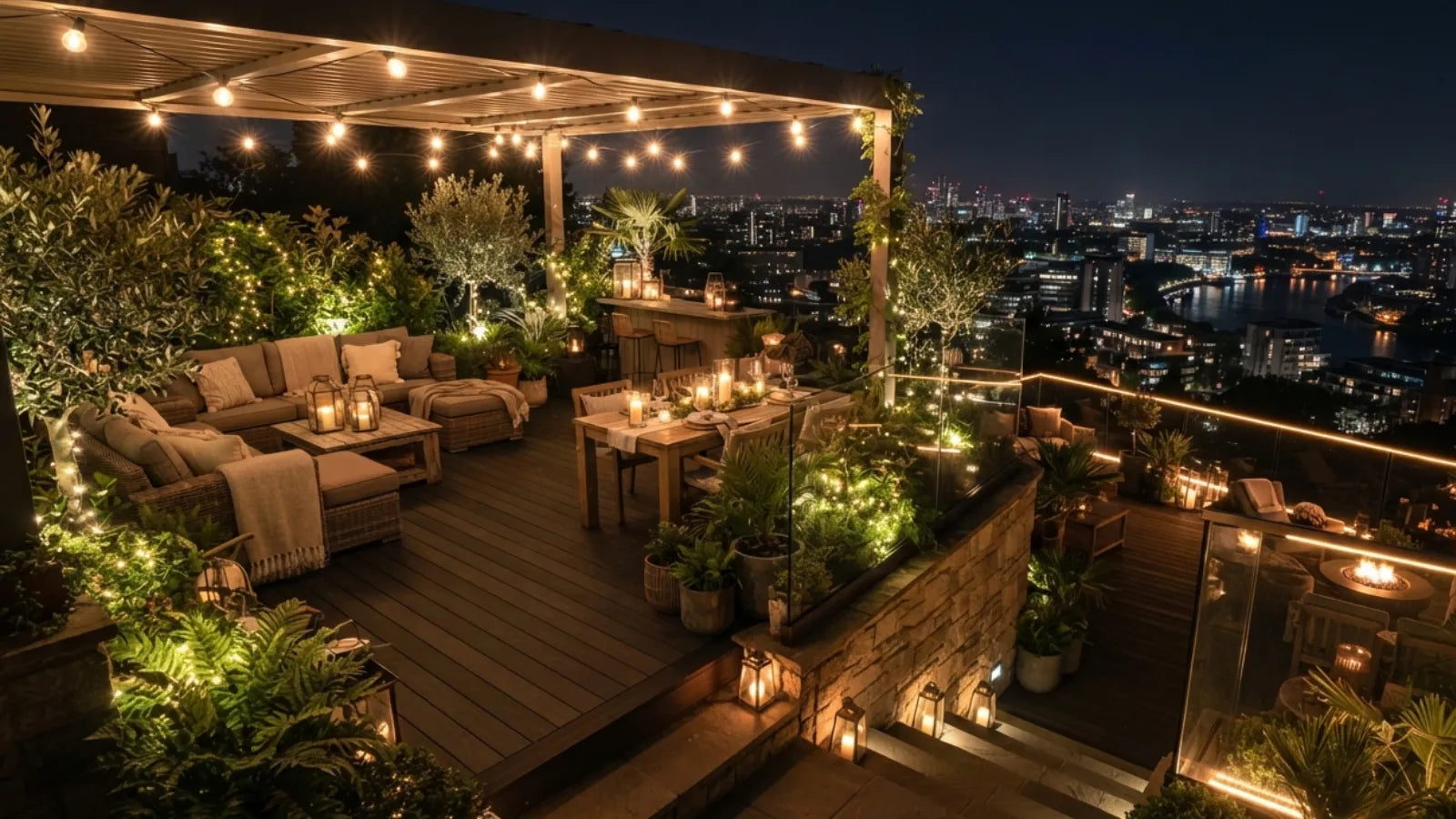
Currently, there is a wide variety of landscape lighting fixtures on the market, with different products catering to distinct functional roles and installation scenarios. To help you gain a systematic understanding, we have compiled the following inventory of mainstream fixture types, each accompanied by a brief description of its core application and typical placement. This list covers everything from basic functional lighting to ambient decorative options and can serve as a practical reference when selecting fixtures for actual projects.
1. Path Lights
Function: Low-level, downward-facing fixtures that illuminate walkways for safety and navigation.
Where to use: Garden paths, driveways, stepping-stone trails, front walkways.
2. Spotlights (Landscape Spots)
Function: Directional, narrow-beam fixtures that highlight a specific object with strong contrast.
Where to use: Trees, statues, flagpoles, architectural columns.
3. Floodlights
Function: Wide-beam fixtures that wash large areas with broad, even illumination.
Where to use: Facades, large trees, sports courts, expansive lawns.
4. Well Lights (In-Ground Lights)
Function: Flush-mounted, upward-facing fixtures installed at ground level for a clean, hidden look.
Where to use: Under trees, along driveways, uplighting walls or columns.
5. Deck & Step Lights
Function: Small recessed or surface-mounted fixtures marking level changes for safety.
Where to use: Deck posts, stair risers, patio edges, retaining wall caps.

6. Wall-Mounted / Sconce Lights
Function: Fixed fixtures attached to a vertical surface, providing ambient or accent light.
Where to use: Exterior walls, garage entrances, porches, gates.
7. Bollard Lights
Function: Post-style fixtures that emit light outward at low height, doubling as visual markers.
Where to use: Driveways, pathway borders, parking areas, property perimeters.
8. String Lights
Function: Flexible strands of small bulbs strung overhead for ambient, decorative lighting.
Where to use: Patios, pergolas, outdoor dining areas, backyard parties.
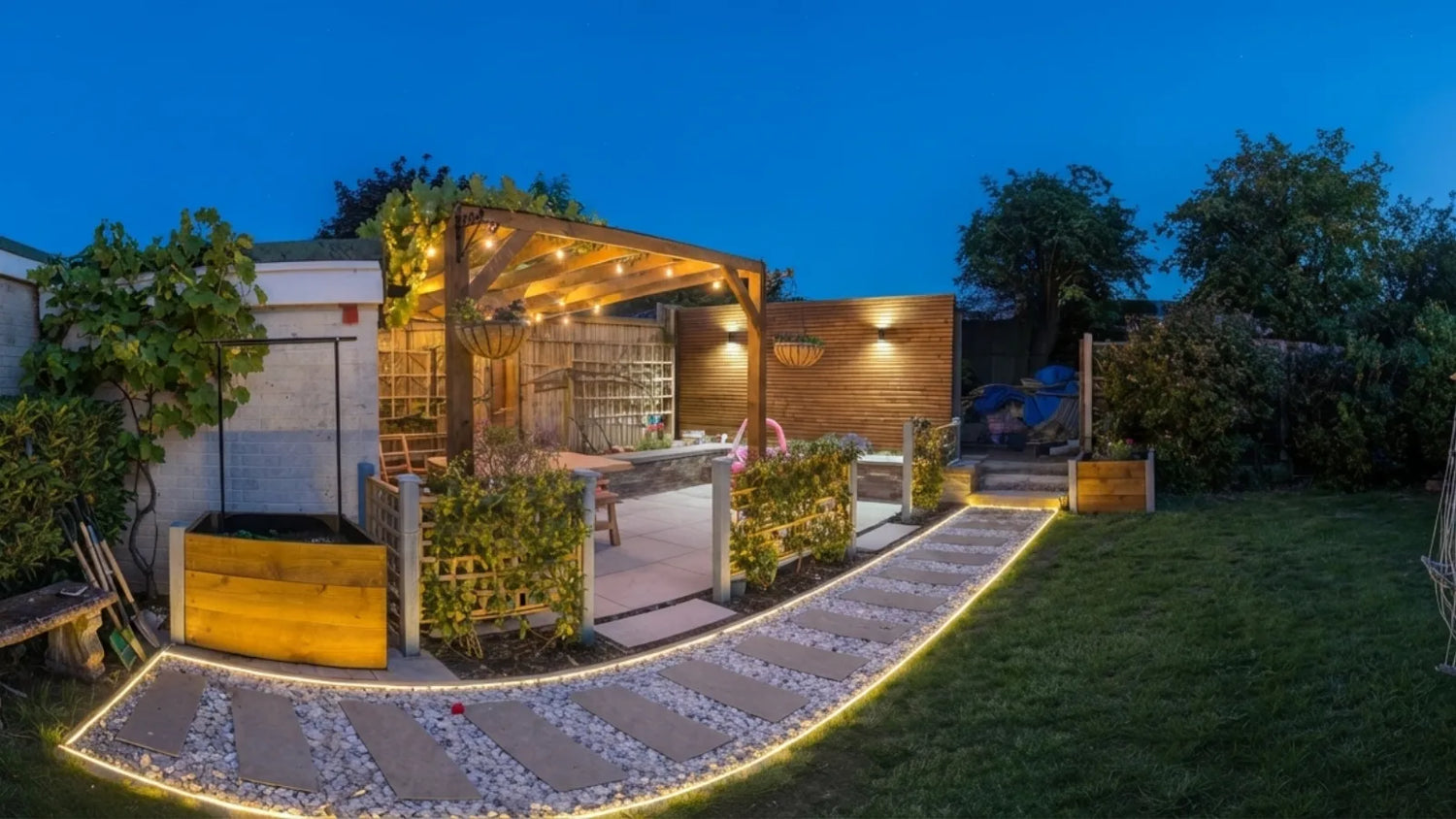
9. LED Strip Lights
Function: Flexible, linear light sources that provide continuous illumination or accenting along edges.
Where to use: Stair edges, deck railings, pergola frames, pool coping, under benches.

10. Underwater / Pool Lights
Function: Waterproof fixtures submerged to illuminate water features from within.
Where to use: Swimming pools, ponds, fountains, water gardens.
11. Solar Landscape Lights
Function: Self-powered fixtures using solar panels and batteries, no wiring required.
Where to use: Remote garden beds, fences, mailbox posts, low-traffic paths.
12. Hardscape / Brick Lights
Function: Recessed fixtures embedded directly into masonry or hardscape surfaces.
Where to use: Retaining walls, brick columns, stone steps, seat walls.
13. Moonlighting Fixtures
Function: Fixtures mounted high in trees and aimed downward to mimic natural moonlight, casting soft dappled shadows.
Where to use: Large canopy trees, wooded areas, backyard seating zones.
14. Silhouette & Shadow Lights
Function: Uplights placed behind an object to project its outline or shadow onto a nearby surface.
Where to use: Ornamental trees, sculptures, decorative shrubs near walls.
15. Hanging / Pendant Lights
Function: Suspended fixtures providing focused downward light from above.
Where to use: Outdoor kitchens, covered patios, gazebos.
16. Motion-Sensor Security Lights
Function: High-output fixtures triggered by movement, combining lighting with security.
Where to use: Entry points, driveways, side yards, dark corners of the property.
17. Uplights
Function: Ground-level or low-mounted fixtures angled upward to accentuate height and texture from below.
Where to use: Trees, columns, house facades, statues.
18. Downlights
Function: Fixtures mounted high (often in trees or eaves) and aimed downward to cast broad, natural-looking light.
Where to use: Patios, seating areas, driveways, general yard illumination.
19. Wall Wash Lights
Function: Wide-beam fixtures placed close to a surface to spread even, glare-free light across its entire face — different from a sconce, which is a fixed decorative wall fixture.
Where to use: Retaining walls, fences, textured exterior walls, feature walls.
20. Garden Lights
Function: Small, decorative fixtures designed to blend into planting beds and softly highlight foliage or flower beds.
Where to use: Flower beds, shrub borders, garden edging, planting containers.
21. Pond and Water Feature Lights
Function: Waterproof fixtures designed for shallow, non-submerged or partially submerged use to highlight moving or still water features.
Where to use: Ponds, fountains, waterfalls, streams.
22. Pool Landscape Lighting
Function: Fully submersible, pressure-rated fixtures built for continuous underwater use in chlorinated or saltwater environments.
Where to use: Swimming pools, spas, in-ground water tanks.
23. Smart Landscape Lighting
Function: App- or hub-controlled fixtures offering scheduling, dimming, color-changing, and voice/remote control.
Where to use: Any landscape zone (paths, facades, gardens, pools) where automated scenes or remote control are desired.
Landscape Lighting Design Tips
Great landscape lighting isn't about lighting everything — it's about creating depth, contrast, and mood through a handful of deliberate techniques. Here are the core design approaches to make a landscape stand out.
1. Layered Lighting
Idea: Combine multiple lighting types (path, up, down, accent) at different heights instead of relying on one fixture type. Layering creates depth and prevents a flat, uniform look.
Best for: Larger properties with varied features — trees, walls, and walkways together.

2. Uplighting for Drama
Idea: Place fixtures at the base of trees, columns, or architectural features and aim upward. This emphasizes height, texture, and bark or stone detail, casting dramatic shadows.
Best for: Mature trees, stone pillars, statues, home facades.
3. Moonlighting for Natural Ambiance
Idea: Mount downlights high in tree canopies to mimic soft, natural moonlight filtering through leaves — creating gentle dappled shadows on the ground below.
Best for: Yards with large, established trees; creates a relaxed, organic atmosphere.
4. Silhouetting and Shadowing
Idea: Position a light behind an object aimed at a flat surface (wall or fence) to project a striking silhouette or shadow pattern.
Best for: Ornamental plants, sculptures, or trees near a blank wall — adds artistic interest at low cost.
5. Grazing for Texture
Idea: Place a fixture very close to a textured surface and angle the beam sharply upward or downward along it, exaggerating shadows and surface detail.
Best for: Stone walls, brick facades, tree bark — highlights texture rather than washing it flat.
6. Cross-Lighting
Idea: Illuminate a single feature from two different angles to soften harsh shadows and create a more three-dimensional, balanced look.
Best for: Specimen trees or focal-point features you want to look natural from multiple viewing angles.
7. Path and Safety Lighting with Rhythm
Idea: Space path lights evenly but not symmetrically — stagger them slightly and vary intensity to create a natural walking rhythm rather than a runway effect.
Best for: Driveways, garden paths, front walkways.
8. Water Feature Accents
Idea: Use submersible or waterproof fixtures to highlight movement — light reflecting off a fountain, waterfall, or pond adds sparkle and a focal point after dark.
Best for: Ponds, fountains, pools, streams.
9. Color Temperature Consistency
Idea: Stick to a consistent color temperature (typically 2700K–3000K warm white) across the whole property, unless intentionally using color-changing fixtures for a specific effect. Mismatched temperatures make a yard look disjointed.
Best for: Whole-property cohesion.
10. Zoning and Smart Control
Idea: Group fixtures into zones (front yard, backyard, pool, garden) controlled independently via a smart system, allowing different scenes for everyday use, entertaining, or holidays.
Best for: Larger properties or homeowners who want flexibility without rewiring.
11. Negative Space (Restraint)
Idea: Not every plant or feature needs light. Leaving some areas dark creates contrast that makes the lit features pop even more.
Best for: Avoiding an overlit, "airport runway" look — often the most overlooked design principle.
Frequently Asked Questions
1. How many lumens do I need for landscape lighting?
Path lights typically use 50–150 lumens, spotlights and uplights 150–300 lumens, and floodlights 300–700+ lumens depending on the area size. Brighter isn't always better — layered, moderate lighting looks more natural than a few very bright fixtures.
2. What color temperature is best for outdoor lighting?
Warm white (2700K–3000K) is the industry standard for residential landscapes because it mimics natural moonlight and complements greenery, stone, and wood tones. Cooler temperatures (4000K+) are typically reserved for modern architectural or security lighting.
3. Can I install landscape lighting myself?
Low-voltage kits (path lights, string lights, solar fixtures) are generally DIY-friendly. Systems involving trenching, transformers, or line-voltage wiring are safer left to a licensed electrician or landscape lighting professional.
4. What IP rating do I need for outdoor fixtures?
IP65 or higher is recommended for general outdoor exposure to rain and dust. Fixtures submerged in water (pool or pond lights) require IP68, which is rated for continuous underwater use.
5. Do solar landscape lights work as well as wired lights?
Solar lights are convenient and wire-free but generally produce less consistent brightness, especially in shaded areas or during winter months with less sunlight. Wired low-voltage systems offer more reliable, consistent output.
6. How long do LED landscape lights last?
Quality LED landscape fixtures typically last 20,000–50,000 hours (roughly 10–20+ years of typical evening use), significantly outlasting halogen alternatives.
7. Can LED strip lights be used outdoors?
Yes, but only strips rated IP65 or higher for outdoor exposure to rain and moisture, or IP68 if they'll be submerged (such as pool coping or water features). Indoor-rated strips will degrade quickly outdoors.
8. Can LED strip lights change color?
Yes — RGB and RGBIC strips can shift through a full color spectrum and are often app or remote-controlled, while RGBIC strips can display multiple colors simultaneously along the same strip for dynamic effects. Tunable white (CCT) strips instead adjust between warm and cool white without color.