Table of Contents
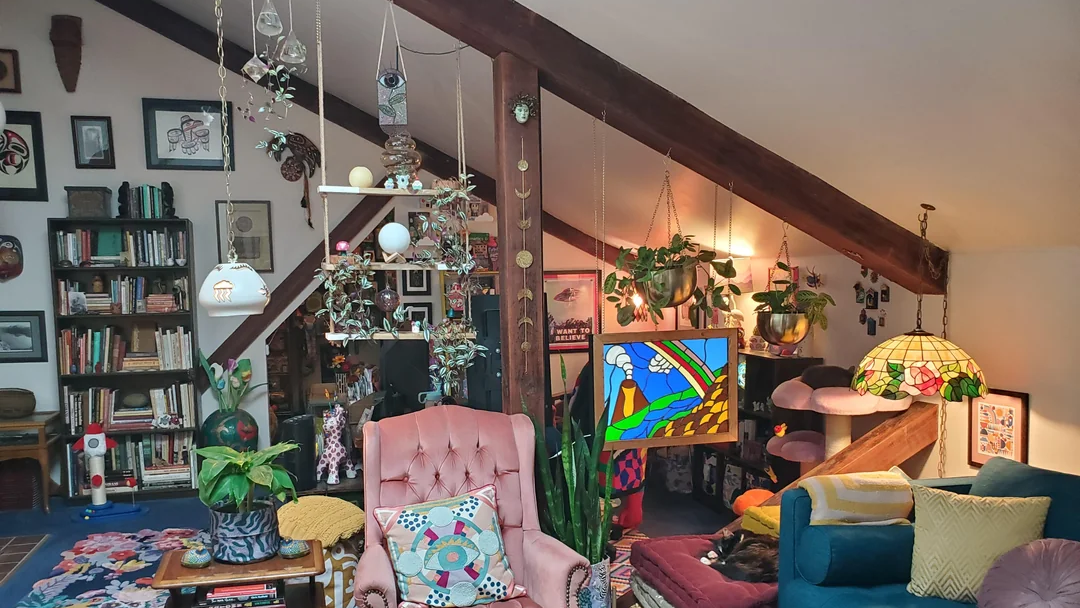
In recent years, minimalism has dominated home design—so much so that many interiors now feel eerily similar, stripped of personality and that warm, playful “home” vibe. But now, a joyful rebellion is underway: eclectic maximalism is making a bold comeback. People are rediscovering the pleasure of decorating—not for Instagram, but for themselves. Whether it’s a shelf full of cherished plush toys, a striking piece of art that screams your taste, or a custom LED neon sign glowing with personal meaning—it’s all about leaning into what you love. The goal? A home that feels vibrant, layered, and unmistakably you.
In this post, we’ll dive into:
- What exactly is eclectic maximalism?
- Real-world, eye-catching interior examples
- How to craft your own eclectic maximalist style
- Creative, actionable decor ideas
What Is Eclectic Maximalist Interior Design?
Welcome back to my design corner. Today, we’re diving into a style that many people both adore and fear—eclectic maximalism.
If the term instantly conjures images of “visual overload,” “sensory chaos,” or even “straight-up clutter”—pause for a moment. That’s not the full story. Let me pull back the curtain: at its core, eclectic maximalism is a deeply personal, highly intentional form of visual storytelling—thoughtful, curated, and alive with character.
Let’s break the term down:
Eclecticism—from the Greek, meaning “selective.” It’s a philosophy: no allegiance to a single era, culture, or style. You might borrow streamlined geometry from 1920s Art Deco, layer in textiles sourced from a Marrakech souk, and place a vintage Scandinavian sideboard beside a bold contemporary painting. Eclecticism is about the freedom to choose—and to mix—with intention.
Maximalism—a direct counterpoint to “less is more,” boldly declaring: more is more. It embraces color, pattern, texture, and object—layer upon layer—celebrating richness, abundance, and sensory vitality. It's a confident expression, not random accumulation.
When the two converge, eclectic maximalism is born. It’s not just mixing—it’s emotionally charged, thoughtful curation. It’s not just excess—it’s abundance arranged with rhythm, harmony, and depth.
Here’s a simple analogy:
If your home were a museum, then:
Minimalism is that pristine white display case holding a single, breathtaking masterpiece.
Traditional design is the orderly gallery wing, neatly organized by period and school.
Eclectic maximalism, by contrast, is the legendary collector’s private salon—where a Renaissance oil painting hangs beside an African ceremonial mask, a vintage scientific instrument rests atop a Persian rug, and nothing is grouped by genre or era. Instead, every object speaks to the owner’s passions, travels, and personal narrative. The space is full—but nothing is there by accident.

So—what’s its core spirit?
Personality above all else: Your home should first and foremost feel like you—not like a page ripped from a glossy magazine. It honors your tastes, memories, and collections, unapologetically.
Layered storytelling: Every object is a fragment of a story. Together, they form a visual autobiography—your life, told in texture, color, and keepsakes.
Harmony through contrast: It doesn’t seek uniformity; it thrives on intentional tension. Disparate pieces are unified not by sameness, but by subtle threads—shared hues, recurring materials, or thematic echoes—that tie the whole together.
So no, eclectic maximalism isn’t about having it all. It’s about choosing—deliberately, joyfully—everything you love, and having the courage to let it shine.
What’s the Difference with Maximalist Interior Design?
Before diving into how to practice eclectic maximalism, we need to tackle a fundamental question: How is it actually different from plain maximalism—a term it’s often confused with?
It’s an easy mix-up: both celebrate abundance, both revel in visual richness, and neither shies away from “more.”
But the key distinction lies not in quantity, but in quality—not in how it looks, but in why it looks that way.
Let’s start with a metaphor:
Maximalism is like a grand, thematically unified opera—every element, from costumes to set design to vocal styling, serves a single, preconceived vision of opulence.
Eclectic maximalism, by contrast, is a spontaneous jazz jam session with virtuosos in the room. Each musician (each object) brings their own distinct voice and history, yet they riff, respond, and harmonize within a shared rhythm—your taste—creating something vibrant, unpredictable, and utterly one-of-a-kind.
Here’s where they truly diverge:
1. Core Philosophy: Unified Narrative vs. Personal Anthology
Maximalism strives for a bold, cohesive, high-impact theme—think “Baroque opulence,” “tropical jungle fantasy,” or “cyber-retro futurism.” Every object is chosen first and foremost to serve that overarching visual concept, with color palettes and patterns often following a strong, intentional logic or gradient.
Eclectic maximalism, meanwhile, curates a collection of personal stories. Its only true theme is you. An object earns its place not because it fits a prewritten script, but because it resonates—emotionally, nostalgically, or purely aesthetically—with you. Its narrative is intimate, fragmented, and deeply subjective; the resulting atmosphere is a chorus of individual tales, harmonizing not by sameness, but by shared sincerity.
2. Visual Logic: Systematic vs. Threaded
In maximalism, abundance is often orchestrated through deliberate design strategies—repetition, symmetry, or tonal gradients—to create a systematic sense of awe. Think: an entire wall lined with identically framed vintage prints, a dense grid of curated collectibles, or a room saturated in a single high-contrast, yet tonally unified, color scheme.
In eclectic maximalism, richness is held together by subtle, hidden threads—not rigid systems. It might be a recurring accent hue (say, amber, flickering across a lampshade, a book spine, and a ceramic glaze), a repeated material (rattan, brass, or raw plaster), or an abstract motif (circles, nautical forms, celestial symbols). At first glance, it feels spontaneous—almost accidental. But look closer: every detail is quietly in conversation with another.
3. Emotional Core: Declarative vs. Autobiographical
Maximalism reads like an outward-facing, bold stylistic manifesto—“Look: this is the ultimate expression of the aesthetic I adore.” It’s confident, theatrical, and unapologetically performative.
Eclectic maximalism, by contrast, unfolds like an intimate, tender visual memoir—“Look: this is where I’ve been, who I’ve loved, and what has enchanted me along the way.” It’s personal, layered, and quietly soulful.
In short:
Step into a maximalist space, and you might think: “Wow—what drama! The owner must be utterly devoted to Victorian opulence.”
Step into an eclectic maximalist space, and you’ll find yourself drawn in, leaning closer, eager to ask: “Where did this tapestry come from? What’s the story behind that painting?” Because here, every corner holds a personal cipher—waiting to be read, not just admired.
To sum it up:
- Maximalism is about taking one style to its absolute zenith.
- Eclectic maximalism is about harmoniously housing countless versions of “you.”
- The former tests your commitment to a single aesthetic vision.
- The latter? It measures your ability to weave a multifaceted life into a space that feels deeply, wholly true.
The Core Principles of Eclectic Maximalism
Master these three principles, and you’ll navigate this style with ease.
1. Every Item Must Carry Your Story
Don’t fill space for the sake of filling it. Each piece you choose—whether pricey or humble—should hold personal resonance: a souvenir from a meaningful trip, a hand-me-down from family, or even just a poster that made your heart skip. Your space is your autobiography; the objects? They’re your sentences.
2. Use “Repeating Threads” to Create Harmony
Mixing wildly different things calls for a little intentional finesse. Anchor the chaos with a simple, recurring thread—like:
- A repeated hue (say, rust-red, echoing across a vase, a book cover, and a throw pillow)
- A consistent material (rattan appearing in a chair, a pendant light, and a tray)
- Or a shared motif (every framed artwork touched with a thin gold frame).
Think of this thread as the rhythm in a song—it doesn’t dominate the melody, but it holds everything together, letting each note shine in sync.
3. Always Include “Breathing Room” and “Layering”
Breathing room: Leave some space bare—a clean wall, an open patch of floor. This gives your collections room to breathe and be truly seen, rather than collapsing into visual static.
Layering: Pair opposites—smooth with rough, soft with rigid (think: a slubby linen sofa + plush velvet cushions; a warm wood coffee table topped with a cool, slick glass tumbler). These textural contrasts add depth, sophistication, and tactile intrigue.
4. Add Lights to Your Room
On weeknight evenings, your home finally becomes yours—and in those hours, lighting is everything. It’s no longer just about illumination; it’s the primary tool for shaping mood and amplifying style.
In eclectic maximalism, lighting itself should be a bold, unapologetic statement—and a custom LED neon sign? That’s the ultimate secret weapon: equal parts art, accent, and emotional spark.
1. It’s the Ultimate Signature of Your Personality
A single phrase, a name, or a symbol—yours alone—pulled into glowing form and mounted on the wall. More personal than any painting, it’s a direct, luminous chapter in your visual autobiography.
2. It’s the Perfect Focal Point in a Layered Space
When your room brims with treasures and textures, a custom neon piece instantly becomes an anchor—a clean, radiant focal point that cuts through the visual richness without competing. It doesn’t simplify the chaos; it orchestrates it.
3. It’s a Master of Mood
Neon light is soft yet dramatic—never harsh, always evocative. It casts a gentle, ambient glow that tints the entire room in your chosen hue, setting the night’s emotional tone in seconds: the hazy warmth of a vintage café, the electric buzz of a late-night studio session—you call the vibe.
In one line:
Curate meaningful pieces, tie them together with subtle threads, let them shine in the quiet, and keep things alive with texture.
Classic Eclectic Maximalist Interior Examples
Now, I’ve gathered a few classic examples to help bring eclectic maximalism to life.
Case Study 1:

The style above is a textbook example of eclectic maximalism. The most striking element? The rug—its bold interplay of yellows, oranges, and blues sets the foundational palette, echoed by the sofa’s soft golden tone.
Then comes green: deep, saturated greens in the table and chairs inject vibrancy and life into the space.
The wall art reveals the owner’s eclectic passions—classical masterpieces hang alongside contemporary pieces, each reflecting a different chapter of their aesthetic journey. Instantly, you feel the person behind the room.
Notice how—despite the visual richness—nothing feels chaotic or cluttered. In fact, it’s remarkably tidy. The result? A space bursting with color, yet somehow light, balanced, and refreshingly alive.
Case Study 2:

This room, too, is a classic exercise in eclectic maximalism. First, the wall color: a generous sweep of deep blue anchors the space—calm, grounded, and quietly dramatic.
Then come the statement pieces: a large-scale abstract painting, paired with a sculptural half-horse bust. Together, they heighten the room’s conceptual, almost poetic sensibility.
Scattered greenery—potted plants placed with intentional irregularity—softens the abstraction, injecting organic energy and a sense of lived-in vitality. The contrast isn’t jarring; it’s essential.
Case Study 3:

This living room centers its energy squarely on the walls—a clear love letter to film and television. The resident is clearly a devoted cinephile, and while the space is densely layered with posters, nothing feels haphazard. Each one is thoughtfully framed, deliberately spaced, and arranged with a keen eye for balance and rhythm. Even though the entire wall is covered, it reads not as clutter, but as a curated gallery—passionate, personal, and impeccably composed.
How to Create an Eclectic Maximalist Home
Enough theory—it’s time to do it. And the safest way in? Start with just one corner. Follow these five steps to ease right in:
Step 1: Anchor with a Foundational Large Piece
Do this: Pick one key large item—like a sofa, bed, or bookshelf. Ideally, it’s a classic silhouette in a neutral tone (think: warm white, deep navy, olive green, or natural wood).
Why: This piece becomes your visual anchor—steady, grounding, and versatile. Think of it as your blank canvas: it gives everything you layer on top room to shine, without tipping the whole scene into chaos.
Step 2: Infuse the “Soul”—Hang Your Core Story
Do this: On your main wall, place one defining visual piece that carries unmistakable personal weight—a large painting, a thoughtfully arranged photo gallery, a vintage textile, or a striking display shelf.
Why: This object should speak directly to who you are or commemorate a pivotal moment. It’s the opening chapter of your space’s narrative—everything else will orbit around it, in conversation, in harmony, in tribute.
Step 3: Establish Your “Thread”—Unfold Your Signature Palette
Do this: Pull 2–3 colors you love directly from your core visual piece—and let them become your throughline. Then, introduce them deliberately across smaller elements: throw pillows, a folded blanket, a ceramic vase, even the spines of stacked books.
Why: Recurring color is the quickest, most intuitive way to create cohesion. It silently links disparate objects, turning a collection of things into a conversation—fluid, intentional, and unmistakably yours.
Step 4: Mix and Layer—the Golden Rule of Arrangement
Do this: Consciously pair objects of varying heights and scales. For example:
Place a low, plump floor cushion beside a tall, slender floor lamp.
On the horizontal line of your sofa, mix vertical-striped pillows with round, plush ones.
Nest side tables and stools of different sizes—some tucked, some staggered, some standing solo.
Why: This intentional asymmetry builds dynamic visual rhythm. It prevents flatness, invites the eye to wander, and breathes energy into the space—like a well-composed song with highs, lows, and pauses that all feel right.
Step 5: The Finishing Touch
Do this: Add just two final elements:
A touch of shine: A brass or ceramic table lamp, a glass candlestick, a custom LED neon sign, or a well-placed mirror. These catch and scatter light softly—adding polish, depth, and quiet luxury.
A spark of life: A lush green plant (think monstera or fiddle-leaf fig) or a simple vase of fresh-cut blooms. Their organic shapes and living energy bring warmth and movement no object can replicate.
Keep this mantra in mind:
Anchor with big furniture → hang your core visual → thread through color → layer high and low → cap it off with light and life.
In Closing
We’ve now journeyed together from the idea of eclectic maximalism to its real-world practice—and one truth stands clear: this isn’t about unchecked accumulation. It’s a deliberate, courageous act of curation—guided by memory, instinct, and deep personal conviction.
At its heart, it’s always about you—your path, your passions, your beautifully unclassifiable spirit. It invites you to tear down stylistic borders: place an heirloom side by side with a flea-market find; let a classical oil painting spark a conversation with a gritty street-print. Every layered corner becomes an outward echo of your inner world.
And once you’ve woven your narrative through color, texture, and treasured objects—don’t forget the final signature: atmosphere, shaped by light. By night, a custom neon sign becomes the irreplaceable soul note of the space: personal, poetic, and unmistakably yours.
So go ahead—start boldly. With a single storied piece of furniture. With a wall that gathers memories like souvenirs. Or with that one glow—made just for you.
Let your home become, unequivocally, the museum you curate.
Because the very best design is always, profoundly, for you.